La marca PIÑATEX realiza textiles, de aspecto similar al cuero, a partir de las fibras que extraen de las hojas de la planta de la piña. El origen de estas fibras está en Filipinas y allí las hojas se desacartaban en la cosecha de la piña.
PINEAPPLE FIBRES FOR TEXTILE USE
The PIÑATEX brand makes textiles,
similar in appearance to leather, from fibres extracted from the leaves
of the pineapple plant. The origin of these fibres is in the Philippines, where the leaves are removed during the pineapple harvest.
Las fibras que se obtienen del tallo de la planta de loto se trabajan cuidadosamente para la realización de productos textiles. son fibras muy caras debido a la dificultad de su obtención y del trabajo delicado que se debe llevar a cabo para obtener hilaturas.
Se pueden encontrar en Vietnam y en Myanmar donde se trabajan tradicionalmente. El corte de los tallos sólo se puede realizar desde abril a octubre y una vez realizado la selección de los tallos se extrae la seda interior. Son fibras muy finas y pegajosas y se obtiene muy poca cantidad de cada tallo. Se enroollan formando hilos y se dejan secar. Este proceso se debe hacer en las primeras 24 h porque al secarse la fibra no resiste el hilado y se rompe. Esto obliga a realizar la cosecha cada día.
LOTUS SILK FIBERS FOR TEXTILES
The fibers obtained from the stem of the lotus plant are carefully worked for the production of textile products. They are very expensive fibers due to the difficulty of obtaining them and the delicate work that must be carried out to obtain spinning.
They can be found in Vietnam and Myanmar where they are traditionally worked. The cutting of the stems can only be done from April to October and once the selection of the stems has been made, the inner silk is extracted. They are very fine and sticky fibers and very little is obtained from each stem. They are rolled up into threads and left to dry. This process must be done in the first 24 hours because when the fiber dries it does not resist spinning and breaks. This means that the harvest has to be done every day.
Fuente información y video / Sourceof information and video:
El
Departamento de Ciencia y Tecnología (DOST-X) y Philippine Textile and
Research Institute (DOST-PTRI) de Filipinas evaluó recientemente los
materiales naturales presentados como iniciativas para la realización de
forma artesanal de mascarillas utilizadas frente a la Covid19. El abacá
se presentó como nueva alternativa sostenible para el desarrollo de
mascarillas principalmente por parte de artesanos de la comunidad Salay Handmade Products Industries, Inc. (SHPII).
Se
realizaron test para evaluar el comportamiento de las mascarillas con
fibras de abacá frente al agua, su grado de absorción y repelencia, la
estructura de las fibras y la porosidad. Los resultados de los análisis
con microscopio mostraron que tiene una porosidad de 10-70µm (tamaño de
poro recomendado para la filtración de partículas peligrosas) y sus
fibras son mas largas que las empleadas en otras mascarillas. Por otro
lado los test de absorción de agua demostraron que las mascarillas de
ábaca absorben 3-5%, siendo más resistente que las mascarillas N-95
(46%). Son mascarillas reutilizables que pueden lavarse hasta 50 veces.
ABACA FIBER MASKS
The masks
The
Department of Science and Technology (DOST-X) and the Philippine
Textile and Research Institute (DOST-PTRI) of the Philippines recently
evaluated the natural materials presented as initiatives for the
artisanal production of masks used in front of the Covid19 . Abaca was
presented as a new sustainable alternative for the development of masks
mainly by artisans from the community Salay Handmade Products Industries, Inc. (SHPII).
Tests
were conducted to evaluate the behavior of masks with abaca fibers
against water, their degree of absorption and repellency, the structure
of the fibers and porosity. The results of the microscopic analysis
showed that it has a porosity of 10-70µm (recommended pore size for
filtration of hazardous particles) and its fibres are longer than those
used in other masks. On the other hand, water absorption tests showed
that abacus masks absorb 3-5%, being more resistant than N-95 masks
(46%). They are reusable masks that can be washed up to 50 times.
Experimentación con fibras de caña común, cortes planos y por otro lado con papel engomado en tiras. Se realizaron con un cilindro y esferas de base hexagonal y pentagonal.
HEXAGONAL WOVEN: SPHERES AND CYLINDERS Experimentation with common cane fibers, flat cuts and on the other hand with paper gummed in strips. They were made with a cylinder and spheres with hexagonal and pentagonal base weaves.
Sydän sauna, Filandia / Finland (2009).
Arquitectos / architects: Teija Losoi, Anne Varsamäki y Ilari Pirttilahti.
El proyecto es una pequeña construcción donde se utilizó la técnica tradicional de tejido ortogonal para conformar el revestimiento de la estructura de madera de la sauna.
La madera de abeto proviene de la familia de las coníferas y es considerada una madera blanda. Es utilizada principalmente para arquitectura de interiores por su baja resistencia a los insectos. Es un buen aislante térmico y su corteza constituye como una superfiecie impermeable.
WOVEN BARK FACADE IN FINLAND
The project is a small building where the traditional orthogonal weaving technique was used to form the wooden structure of the sauna. Spruce wood comes from the coniferous family and is considered a soft wood. It is mainly used for interior architecture because of its low resistance to insects. It is a good thermal insulator and its bark is like a waterproof surface.
Se cortaron finas tiras de corteza de abeto, que se colocaron tejiendolas en dos direcciones ortogonales, cubriendo así toda la superfiece exterior e interior. El tejido reviste la estructura de madera de la sauna. Las uniones de los trozos de corteza fueron cosidos con tiras de cueropara dar continuidad y obtener las tiras que debían entretejerse.
Thin strips of fir bark were cut and placed in two orthogonal directions, covering the entire outer and inner surface. The fabric covers the wooden structure of the sauna. The joints of the pieces of bark were sewn with strips of leather to give continuity and to obtain the strips to be interwoven.
VISITA AL MUSEO DE ARQUEOLOGÍA TEXTIL E INDUSTRIAL EN GANTE (BÉLGICA)
El MIAT es el antigua fábrica de hilados que funcionó durante el siglo XVIII en Gante. Actualmente se puede visitar y durante el recorrido se muestran las maquinarias y herramientas utilizadas desde la llegada del algodón, la materia prima, a la fábrica hasta la realización del hilado fino y el teñido de las fibras.
FORMER COTTON SPINNING MILL IN GENT
VISIT TO THE MUSEUM OF TEXTILE AND INDUSTRIAL ARCHAEOLOGY IN GENT (BELGIUM)
MIAT is the oldest yarn factory that operated during the 18th century in Gent. At present it is possible to visit and during the tour you can see the machinery and tools used from the arrival of the cotton, the raw material, to the factory to the fine spinning and the dyeing of the fibres.
La cubierta de la Iglesia Qatay en el Distrito de Incahuasi
(Perú) se renueva cada 10 años en un acontecimiento que reúne a todo el pueblo.
La Iglesia está construida por 5 muros gruesos de adobe y 28
columnas de madera talladas sobre el que descansa el techo de la cubierta a dos
aguas con gran inclinación y manojos de paja Stipa Ichu que dan la terminación y el remate garantizando la impermeabilidad. La cubierta que sobre sale de los muros se sostiene
por columnas de madera sin trabajar.
La cubierta esta formada por troncos principales de madera y
palos secundarios generalmente de madera de aliso.
STIPA ICHU COVER OF THE QATAY CHURCH IN PERU
The roof of the Qatay Church in the District of Incahuasi (Peru) is renewed every 10 years in an event that brings together all the people. The church is built with 5 thick adobe walls and 28 carved wooden columns on which rests the roof of the gable roof with a steep slope and bundles of Stipa Ichu straw that give the finish guaranteeing waterproofness. The roof above the walls is supported by unworked wooden columns. The roof is formed by main wooden trunks and secondary sticks generally made of aliso wood.
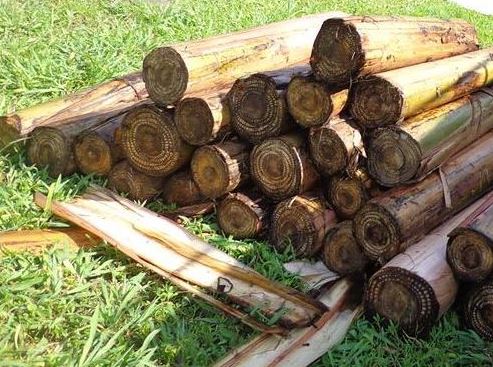
La fibra de banano se extrae de los tallos de la planta y se utiliza en varios lugares para la realzación de tejidos. Tiene un color amarillo claro y al utilizarlas en artesanías muchas se tiñen. Es una fibra ligera, se adapta a la humedad, con aspecto algo brillante, no elástica pero flexible.
BANANA FIBER WOVEN IN ECUADOR
Banana fibre is extracted from the plant's stems and used in various places for weaving. It has a light yellow color and when used in crafts many are dyed. It is a light fibre, adapts to humidity, with a somewhat shiny, non-elastic appearance and but it is flexible.
Las islas flotantes del pueblo Indigena Uros están construidas a 3810 msnm en el lago Titicaca que es compartido por Perú y Bolivia. Las Islas las construyen con totora (Scirpus californicus) que crece dentro del lago y es una fibra fuerte y habitualmente utilizada para la construcción de barcas o viviendas. Actualmente estas islas son de gran atractivo turístico y el paso de mas gente por allí hace que las islas requieran mayor mantenimiento. FLOATING REED ISLANDS IN THE TITICACA LAKE The floating islands of the Indigena Uros people are built at 3810 meters above sea level on Lake Titicaca, which is shared by Peru and Bolivia. The Islands build them with reed (Scirpus californicus) that grows inside the lake and is a strong fiber and usually used for the construction of boats or houses. Currently these islands are of great tourist attraction and the passage of more people through there makes the islands require more maintenance.
Las islas al estar construídas con un material orgánico tienen un proceso de desgaste y de cambios propios de su naturaleza y del uso, es por ello que el proceso constructivo en este caso es continuo.
EL proceso constructivo de las islas flotantes se basa en la superposición de capas colocadas en direcciones contrarias creando un tejido trabado. Las islas flotan por las burbujas de aire, disminuyendo su densidad, que quedan entre el entretejido que se forma en medio de las totoras superpuestas.
El proceso constructivo se puede describir en diferentes pasos y su ciclo está en continua renovación.
The islands, being built with organic material, have a process of wear and tear and changes in their nature and use, which is why the construction process in this case is continuous. The constructive process of the floating islands is based on the superimposition of layers placed in opposite directions creating a locked weave. The islands float through the air bubbles, decreasing their density, which remain between the interweaving that forms in the middle of the superimposed totoras. The construction process can be described in different steps and its cycle is in continuous renovation.
En el lago Titicaca, que divide Bolivia y Perú, las plantas de totora (Schoenoplectus californicus) son fundamentales para el desarrollo de sus pueblos, ya que se utilizan para la construccion de viviendas, la construcción de nuevas islas, para artesanías, papel, para medicamentos, alimentación y para la construcción de barcas con métodos tradicionales.
Las barcas se utilizan para moverse por las islas, para pescar y para el turismo. La técnica constructiva es preincaica, valiéndose únicamente del atado de fibras vegetales como son la totora y la pita(Agave).
REED BOATS IN TITICACA´S LAKE
In Titicaca´s Lake, which divides Bolivia and Peru, reed plants (Schoenoplectus californicus) are fundamental for the development of their villages, since they are used for the construction of houses, the construction of new islands, for crafts, paper, for medicines, food and for the construction of boats with traditional methods. Boats are used for island travel, fishing and tourism. The construction technique is pre-Inca, using only the binding of vegetable fibers such as totora and pita (Agave).
Los hilados y trenzados de yute se utilizan para formar las suelas de las alpargatas o esparteñas, por ejemplo.
Para el proceso industrial se cuenta con uno o mas tipos de hilos de yute, dependiendo de las calidades que se busquen, ya que el trenzado se puede disponer de cuerdas que conformen el alma y cuerdas que configuren la parte externa. La técnica de trenzado de cuerda se utiliza para dar mas resistencia y generar una cuerda mas gruesa.
INDUSTRIAL PLAITING WITH JUTE FIBRES, VISIT TO ESPARTOS SANTOS (II)
Jute yarns and plaiting are used to form the soles of espadrilles or esparteñas, for example. For the industrial process, one or more types of jute yans are available, depending on the qualities being sought, since the braiding can be provided with ropes that conform the core and ropes that configure the outer part. The rope braiding technique is used to give more resistance and generate a thicker rope.
Murcia es, tradicionalmente, la provincia de donde provenía la mayor cantidad de esparto e históricamente allí se encontraban las fábricas llamadas esparterías donde se trabajaba con estas fibras para trenzados, cordelería, etc.
En Julio visité una de las pocas esparterías que sigue en funcionamiento y que amplió su trabajo aumentando la variedad de fibras. En tres grandes naves se reparte el trabajo de Espartos Santos en Cieza (Murcia, España), allí José Antonio Santos me explicó el proceso de indusrtrialización que reciben las fibras. Actualmente reciben fibras de sisal desde Madagascar, Brasil, Kenia o Tanzania y de yute desde Bangladesh o India, también reciben esparto obtenido manualmente de algunas personas de la zona.
VISIT TO ESPARTO SANTOS IN MURCIA (I) Murcia, Spain, is traditionally the province from which most straw originated and historically there were the factories called straw factories where these fibers were used for braiding, cordage, etc. In July I visited one of the few remaining starw factories in operation that expanded their work by increasing the variety of fibers. In three large ships the work of Espartos Santos is divided up in Cieza (Murcia, Spain), where José Antonio Santos explained to me the process of industrialization that the fibers receive. Currently they receive sisal fibres from Madagascar, Brazil, Kenya or Tanzania and jute fibres from Bangladesh or India, as well as esparto obtained manually from some people in the area.
La segunda parte de la visita a la Espartería J. Sanchez tiene que ver con el trabajo realizado con ratán.
El ratán se utiliza de diferentes formas y en la Espartería se puede obtener desde una pieza entera hasta en fibras llamadas médula que es una tira del interior del ratán con sección circular, fibras llamadas tireta que se extraen de la corteza del ratán y tienen sección rectangular; y también esterillas que son tejidos hexagonales planos realizados con tireta.
RATTAN FIBERS
The second part of the visit to the Sanchez Esparteria has to do with the work done with rattan. The
rattan is used in different ways and in the Esparteria can be obtained
from a whole piece even in fibers called médula which is a strip of the
interior of the rattan with circular section, fibers called tireta that
are extracted from the bark of the rattan and have rectangular section ; And also mats that are flat hexagonal weaving made with tireta.
Para saber mas sobre la obtención de fibras naturales y sus usos me acerqué uno de los primeros días de junio a conocer el trabajo que se realiza en la Espartería J. sánchez en Madrid. http://www.esparteria.com/
Tuve la oportunidad de que Juan me recibiera y me mostrara las fibras que tiene en venta y con las que trabaja para confeccionar desde cuerdas trenzadas de esparto hasta la restauración de sillas con esterillas de ratán.
VISIT ESPARTERÍA J. SÁNCHEZ
To know more about the
obtaining of natural fibers and their uses I approached one of the first
days of June to know the work that is done in the J. Sanchez Esparteria
in Madrid. Http://www.esparteria.com/ I
had the opportunity of Juan to welcome me and show me the fibers he has
for sale and with which he works to make from braided strings of
esparto to the restoration of chairs with rattan mats.
Los gaviones de bambú forman parte de la ingeniería hidráulica tradicional de Asia, principalmente de China.
Estos tejidos rellenos de piedras conformaban sistemas de retención de aguas de los ríos de China, junto con otros métodos como el uso de fajinas de cañas de gramíneas atadas con cuerdas de bambú se colocaban en los diques de aproximadamente 10 metros de altura.
Además los gaviones gigantes se utilizaban como sustento de pasarelas o puentes que por facilidad constructiva y por su ligereza permitían una construcción rápida y eficiente.
BAMBOO GABIONS IN ASIA
Bamboo gabions stuffed with stones are part of the traditional hydraulic engineering of Asia, mainly China.
These weavings were part of restraint systems of the rivers of China, along with other methods such as the use of reeds of grass tied up with strings of bamboo were placed in the dikes of approximately 10 meters of height.
In addition the giant gabions were used as sustenance of gateways or bridges that allowed a rapid and efficient construction for building ease and because of its lightness.
El
próximo
miércoles día 21 de junio, dentro del ciclo de conferencias y ponencias
del GIGAC, contaremos con una sesión a cargo de Eugenia Muscio y Jesús
Anaya Díaz, con título Geometría, estructura y nudo en la constitución
de entramados espaciales con fibras de bambú. La sesión tendrá lugar en el aula 2S3 de la ETSAM, a las 18:00 horas.
Fue un avión diseñado en los años ´30 y que se utilizó durante la Segunda Guerra Mundial.
Fue diseñado por Barnes Wallis un ingeniero inglés que participó continuamente en la innovación aeronáutica. El bombardero Wellington destacaba por su estructura que estaba formada por un tejido de rombos que constituía el fuselaje y las alas.
THE WELLINGTON
It was a plane designed in the years ´30 and that was used during the Second World War. It was designed by Barnes Wallis an English engineer who participated continuously in aerospace innovation . The Wellington bomber was notable for its structure which consisted of a weaving of rhombuses that constituted the fuselage and the wings.
En el recorrido por los pueblos de la sierra de Ecuador se pueden encontrar diversas construcciones tradicionales, muchas que se continúan usando y otras vacías pero que aún siguen en pie. La aparición del bloque de hormigón como sistema constructivo desplazó el uso de las fibras vegetales y la metodología constructiva popular, que aunque resulta menos eficiente el bloque de hormigón en cuanto a la adaptación al clima de la sierra se adoptó por su sistematización.
En una visita realizada al interior de una vivienda sin uso, se puden identificar las diferentes fibras utilizadas en su construcción. Las fibras naturales como la caña brava, cuerdas de coco, paja, madera de eucalipto (utilizada directamente en las estructuras de cubierta o para mobiliario), los tejidos de hoja de palma y cabuya, etc. están presentes en la construcción de toda la vivienda.
NATURAL FIBERS IN THE HOUSES OF THE SIERRA OF ECUADOR Travel through the towns of the sierra of Ecuador you can find several traditional buildings, many who continue using and other empty but that are still standing. The appearance of the block of concrete as a construction system displaced the use of vegetable fibers and the popular construction methodology, although it is less efficient concrete block in terms of adaptation to the climate of the sierra was adopted by its systematization. In a visit to the interior of a house without use, it can identify the different fibers used in its construction. Natural fibres as the cane, ropes of straw, coconut, palm and sisal leaf weaves, eucalyptus wood (used directly in the roof structures or furniture), etc. are present in the construction of the home.
Los Agaves son plantas que crecen naturalmente en zonas con terrenos poco drenados y bajas precipitaciones. Se caracterizan por sus hojas gruesas y son muy tolerantes a climas secos y soleados.
Tradicionalmente utilizadas para obtención de fibras con fines de usos textiles, cordelería, etc. El Agave sisalana conocido habitualemente como "sisal" ya que el origen de su distribución fue en la Península de Yucatán (México) en el puerto que llevaba ese nombre, es una de las fibras que mas se utilizan hasta la actualidad y de las que se puede obtener distintas calidades y longitudes.


 1


 (1)
 (2)
 (3)


 (1)
 (2)
 (1)
 1


 (1)

 (1)


 (1)